AI, One Phone Call Away
I went to Busia and Ahero expecting disappointment.
Then someone asked whether there was a human speaking on the other end of the line.
That was a very good way to be wrong.
As an engineer, you develop an excellent imagination for failure. You know where a system might misunderstand a question, where an unfamiliar phrase might confuse it, and how a little background noise can complicate an otherwise straightforward interaction. Before field testing, those possibilities tend to occupy a generous amount of space in your head.
They certainly occupied mine.
Alongside my colleague Betty Kyallo and the wider team, I spent a week working with farmers from Hello Tractor in Busia and Ahero. We were deploying and testing the Nia Voice AI Agent under the AI Hub for Sustainable Development, with technical guidance from Crane AI Labs.
I had arrived thinking about how much could go wrong. The response we received gave me a much stronger sense of what could go right.
The moment someone wondered whether they were speaking to a human stayed with me. It suggested that the interaction felt familiar enough for that question to arise. For someone who spends much of his time working on speech technology, that was quite a moment.
Then there was the simplicity of how people could reach it.
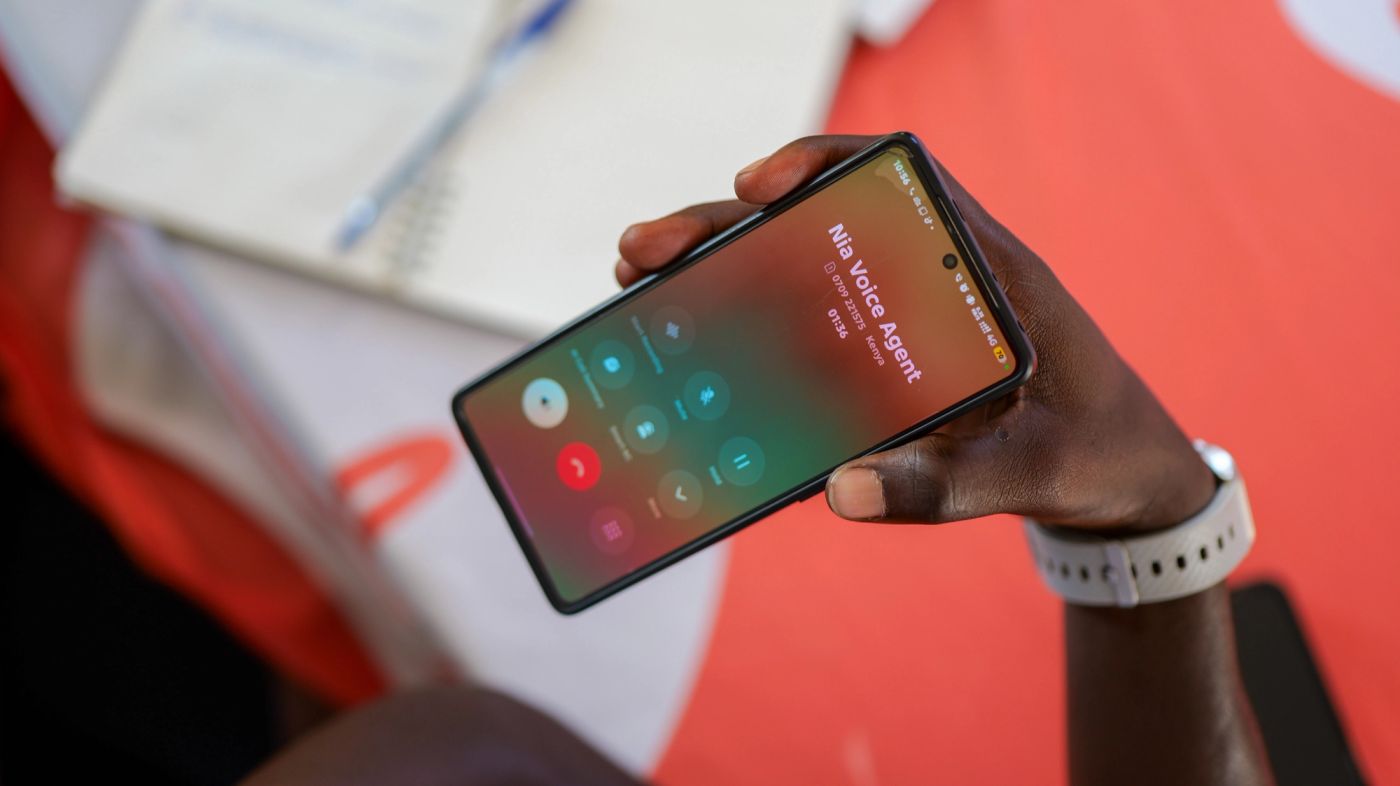
Farmers could call the agent through an ordinary phone call, using airtime. On the caller’s side, there was no app to install or mobile data bundle required. They could dial a number and speak.
I think that deserves more attention than it sometimes gets.
We talk a lot about democratizing AI. Here was a concrete version of that idea: putting access to an AI agent within an interaction people already understand. A phone call. A question asked in familiar language. A spoken response.
There is a great deal of engineering behind making that possible. The person calling should be able to experience it as something simple.
This is part of what makes voice so interesting to me. We can bring new capabilities into an existing habit. Someone who knows how to make a phone call already understands the first step. That gives us a useful starting point for making AI accessible to more people.
It also makes the remaining barriers easier to see. Airtime still costs money. Long pauses and unnecessary repetition can make a call more expensive. The service needs to be available when someone needs it. Access has to remain practical after the excitement of a first conversation.
The farmers brought these larger questions into focus through their discussions about reliability, access, and equality. Their response went beyond what I had expected from the week. It pushed me to think more seriously about what people should be able to demand from this technology.
Reliability, for example, has a very human meaning. Can I depend on this? Will it understand me next time? Will it help when my question is phrased differently?
For us as engineers, that means looking at the whole interaction over repeated use. A service earns trust through useful answers, consistent availability, and the ability to recover when something goes wrong. A convincing first call gives us something to build on. People’s willingness to keep using it depends on what follows.
The conversations about equality were equally valuable. For me, they raised a practical question: how evenly does the experience work across the people we hope to serve?
An agent should be able to handle different accents, speaking styles, and levels of confidence with technology. We need to pay attention to who gets understood easily and who has to keep trying. Those differences can disappear inside a single performance score unless we deliberately look for them.
That connects directly to my work at MsingiAI.
As a co-founder and voice researcher, I have been working with our team on Sauti, our Swahili speech recognition and speech generation work. The ambition is to make technology easier to use in the languages people actually speak. Working on Nia with farmers gave that ambition a more immediate, practical meaning.
People move between Swahili and English naturally. They use local expressions and familiar shorthand. They do not plan their sentences around a model’s training data.
Our systems have to get better at following them.
That means taking Kenyan speech, code-switching, and everyday phrasing seriously throughout development. It affects the data we work with, the conversations we test, and the mistakes we prioritize. A sentence can be mostly transcribed correctly while losing the one detail that matters to the answer.
The field also gave us some specific issues to improve, including a little background noise and occasional hallucinations.
Noise gives us practical work around audio handling, testing in representative conditions, and helping the agent ask for a detail again when necessary. With hallucinations, we need to examine why an answer went beyond what the system could support, strengthen its use of dependable information, and improve clarification and uncertainty handling.
These are addressable engineering challenges. We need to reduce their frequency, check the improvements against the cases that exposed them, and keep testing. The naturalness of the voice makes answer quality especially important: a response that sounds convincing still needs to be dependable.
I came away wanting our evaluations to capture more of the experience farmers actually have. Did the person get useful help? How much repetition was necessary? Could they correct a misunderstanding? Was the response clear? How much time and airtime did the interaction take?
Those questions give research a practical direction. An observation becomes a test case. A recurring difficulty becomes a development priority. Feedback from someone making an ordinary phone call helps us decide what deserves attention next.
That is a connection I want to keep strengthening at MsingiAI: the connection between the speech technology we build and the people whose conversations give it a purpose.
I am more optimistic after this week. The response exceeded my expectations, and the improvements ahead feel more concrete. The farmers gave us both encouragement and a clearer standard to work towards.
As we build towards UNGA 2026, I am looking forward to sharing that progress. I hope we also keep the ordinary phone call at the center of the story. It says something important about the future we could build: useful AI that people can reach through the devices, languages, and habits already part of their lives.
I went into the field prepared to be disappointed. I came back thinking about how much becomes possible when access to AI begins with a number you can call.
Thank you to the farmers who shared their time and feedback with us, my colleague Betty Kyallo, the Hello Tractor team, Kato Steven Mubiru and Crane AI Labs, Mildred Rebecca Namagembe, and my team at MsingiAI. I am grateful to the AI Hub for Sustainable Development, Keyzom Ngodup Massally, Raiyan Arshad, Dwayne Carruthers, EkStep Foundation, CINECA, and Africa Compute Fund for supporting this work.