Five Things We Get Wrong About Building AI for Africa
Introduction: The Language Trap
When we talk about making Artificial Intelligence work for Africa, the conversation often starts and stops with one, seemingly obvious challenge: language. The intuitive assumption is that if we can just teach AI to speak Swahili, Yoruba, or Hausa, we will have solved the problem of digital inclusion. After all, most of the world’s leading AI models were trained on Western data, leaving hundreds of African languages behind.
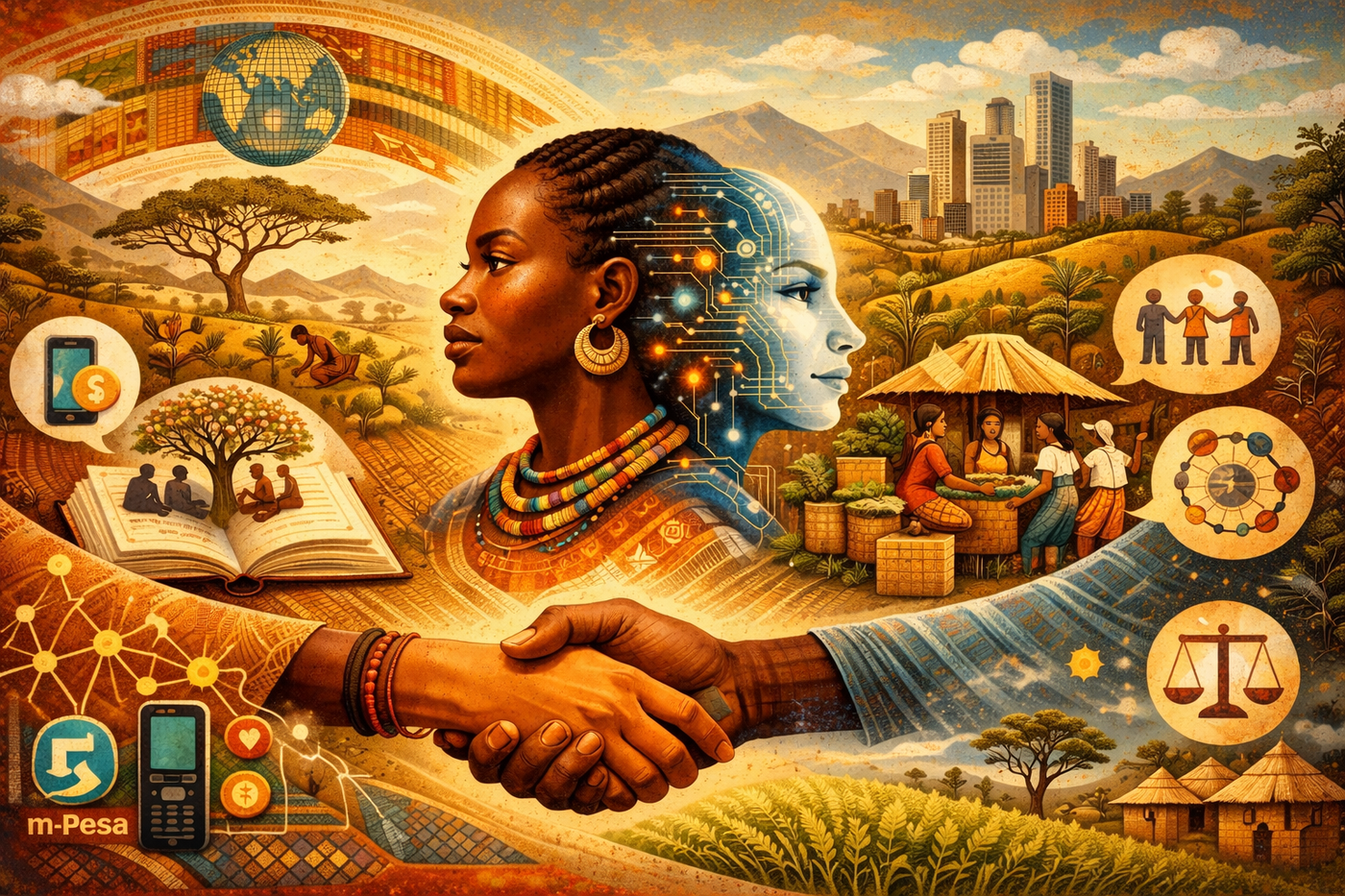
While adding more languages is a crucial step, this focus is dangerously incomplete. It’s the tip of the iceberg, obscuring a much deeper and more complex problem. True inclusion isn’t just about translating words; it’s about understanding worlds. We wrote a position paper at MsingiAI and we argue that for AI to be genuinely useful, it must be grounded in the local context — the cultures, histories, socio-economic conditions, and daily realities of the people it aims to serve.
This post explores five critical and often surprising takeaways from their work that reframe how we should think about building AI, not just for Africa, but for the entire world.
1. It’s Not About More Languages, It’s About Deeper Context
An AI can translate every word in a sentence perfectly and still completely miss the point. The gap between literal translation and true meaning is where context lives. Without understanding the cultural framework behind the words, an AI is just a dictionary — not an intelligent partner.
African communication, for instance, often relies on proverbs to convey wisdom and advice. A simple machine translation might render the Swahili proverb “Haraka haraka haina baraka” as “Hurry, hurry has no blessing.” While technically correct, this translation fails to capture the deeper cultural wisdom about the virtue of patience and the dangers of rashness. The essence is lost. This same gap appears whether the AI is giving advice on Kenyan farming practices, local health beliefs, or informal finance systems — domains where local knowledge is paramount.
This distinction is critical because an AI that lacks context risks being useless at best. At worst, it can provide advice that is tone-deaf, culturally inappropriate, or practically irrelevant, failing the very communities it was designed to help.
2. AI Can Inherit Our Hidden Biases
Because the vast majority of state-of-the-art Large Language Models (LLMs) are trained on data from and about the Western world, they can absorb a Western-centric worldview without any explicit instruction to do so. This creates hidden preferences that can disadvantage other cultures.
A stunning 2024 study by Ryan et al. found this in action. A reward model — a key component used in Reinforcement Learning from Human Feedback (RLHF) to “align” AI with human preferences — consistently gave higher scores to content associated with Western countries and lower scores to content about African ones. This shows that the very process of making AI “helpful and harmless” can inadvertently encode a bias against non-Western contexts.
This ethical dimension is a growing concern. As researchers Gwagwa et al. (2022) point out, the problem runs deep in the principles guiding AI development:
…current AI ethics principles are grounded in Western individualism, whereas African societies emphasize communal values like Ubuntu.
This means “alignment” is not a neutral process. It encodes a specific set of cultural values. This encoding of Western values is not just about preferences; it reflects a fundamental blindness to other ways of knowing and reasoning, a challenge that goes to the heart of what ‘intelligence’ even means.
3. True ‘Intelligence’ Must Understand Proverbs and Storytelling
Not all knowledge is written down in encyclopedias or academic papers. This is what researchers call “Epistemic” context — the different ways societies create, store, and share knowledge. In many African cultures, wisdom is passed down orally through storytelling, using “proverbs-as-logic” and relying on “folk wisdom as evidence.”
A powerful example is the concept of Ubuntu, often translated as “I am because we are.” This philosophy represents a relational, communal form of ethics that stands in contrast to the emphasis on individualism common in Western thought. Knowledge and decision-making are often framed within the context of the community’s well-being.
For AI design, this has profound implications. An African-contextualized AI assistant might need to frame advice collectively (“This is what would be best for our community”) rather than personally (“This is what you should do for you alone”). For an AI to feel natural, trustworthy, and truly intelligent to its users, it must understand and respect these foundational knowledge systems.
4. The Best AI Might Run on a Basic Phone, Not a Supercomputer
The popular image of AI involves massive data centers and supercomputers. But for AI to be effective in many parts of Africa, its design must be grounded in socio-economic realities. For millions of people, digital life is mobile-first, often experienced through basic smartphones on low-bandwidth connections where every megabyte of data counts.
This means the most impactful AI tools won’t be the largest models, but lightweight systems designed to address technical challenges like “tokenization biases” and the need to “compress models for edge use” on smaller devices or via SMS. The context of use dictates the technology.
Consider an AI giving financial advice. A generic model trained on Western data might suggest opening a bank account or investing in the stock market. This advice completely misses the reality of many informal economies where mobile money systems like M-Pesa and community-based “rotating savings groups common in West Africa” are the central pillars of financial life. To be useful, the AI must understand the world its user actually lives in.
5. Solving for Africa Could Pioneer Fairer AI for Everyone
The challenges of building context-aware AI in Africa are not unique to the continent. The push to solve these problems offers a powerful blueprint for creating more equitable AI everywhere, particularly in other culturally diverse and multilingual regions like South Asia, Latin America, and among Indigenous communities in the Global North.
The core problem — a “one-size-fits-all” model that imposes a dominant culture’s norms and ignores local realities — is a universal issue. Whenever a technology developed in one context is deployed in another, these same blind spots appear.
By focusing on solutions for Africa, researchers are developing methodologies that can benefit the entire world. Methodologies like participatory data collection involving local communities and context-driven evaluation that measures cultural appropriateness are essential for building fairer systems globally. In this sense, Africa is not simply a passive recipient of technology but a leader in the global effort to make AI more equitable, representative, and truly intelligent.
Conclusion …..Beyond Words
To build AI that is truly helpful and inclusive for communities across Africa, we must move beyond the simple goal of adding more languages. The real work lies in embedding a deep, local context into these systems, teaching them to understand the world as their users do.
This means building models that recognize the wisdom in a proverb, respect communal values, and operate within the constraints of mobile data costs. It requires a fundamental shift from building a universal intelligence to cultivating a mosaic of culturally informed intelligences. This is not a regional fix, but a blueprint for a more equitable global AI ecosystem. As we build the intelligence of the future, how can we ensure it reflects the full, diverse tapestry of human wisdom and experience?