Why AI Needs Culture (And Culture Needs Better AI)
Reflections on the AI Across Cultures workshop at CHI 2026 and why we are building AI wrong for most of the world
Here is something that keeps me up at night: of the roughly 7,000 languages spoken on Earth, most AI research focuses on about 20 of them.
Let that sink in. Twenty languages. Out of seven thousand.
The rest? They are what we politely call "low-resource languages." What we should call them is "the languages we have decided are not worth the effort." These languages represent billions of people, entire cultural universes, and ways of seeing the world that AI simply does not know exist.
This is not just a technical problem. It is a choice the industry keeps making, over and over again. And it is exactly why I am co-organizing the AI Across Cultures workshop at CHI 2026 in Barcelona.
The Uncomfortable Truth About "Universal" AI
When Silicon Valley talks about building "universal" AI systems, what they really mean is universal for English speakers. Maybe Mandarin. Spanish if we are lucky. French on a good day.
But what about Swahili? Luganda? Yoruba? What about the 2,000+ languages spoken across Africa, or the indigenous languages of the Americas and Asia that are rapidly disappearing?
The standard response is "there is not enough data." Which is technically true but fundamentally a cop-out. It is like saying we cannot build schools in rural areas because there are not enough educated people there yet. The logic eats itself.
Here is what is actually happening. Our AI systems are trained on data scraped from the internet. And the internet, despite its global reach, is profoundly unequal. About 60% of web content is in English, a language spoken natively by only 5% of the world's population. Most of humanity's knowledge, culture, and ways of thinking simply do not exist in digital form at the scale AI companies need.
So when we deploy these "universal" models globally, we are not democratizing AI. We are colonizing minds with Silicon Valley's worldview, packaged as technological progress.
It Is Not Just About Translation
You might think we can just translate everything into English, train the AI, then translate the outputs back.
No. God, no.
Language is not just words swapped for other words. It is how we structure thought, how we relate to each other, how we understand time, agency, relationships, and even what counts as knowledge in the first place.
Take the concept of Ubuntu from Southern African philosophy: "I am because we are." It is a fundamentally relational view of personhood that does not map cleanly onto Western individualism. How would GPT-4, trained primarily on Western text, understand or generate advice rooted in Ubuntu? It wouldn't. It couldn't. The underlying worldview is not in its training data.
Or consider how many African and Asian languages encode respect through grammatical structures, verb conjugations, and pronouns that English simply does not have. When you translate into English, you lose the social context. When you translate back, you are guessing.
When AI systems fail to understand cultural context, they do not just make mistakes. They make consequential mistakes. Medical diagnoses that miss culturally specific symptoms. Educational tools that teach children their home language is "incorrect." Justice systems that misread cultural norms as deception.
The Data Scarcity Trap
The AI industry has convinced itself that low-resource languages are unsolvable because there is not enough digital text to train on. But here is what they are missing: there IS data. It is just not in the form Silicon Valley expects.
In Rwanda, health workers use WhatsApp to coordinate patient care in Kinyarwanda. In Kenya, market vendors negotiate prices in Swahili and Kikuyu mixed with English. In Nigeria, millions of tweets blend Yoruba, Igbo, and Pidgin English in ways that confuse language detection algorithms.
The problem is not data scarcity. It is that we have built our entire AI infrastructure around assumptions that do not hold outside high-resource contexts:
- We assume text is freely available on the open web (it is often in private groups or paywalled local news).
- We assume standardized spelling (many languages have multiple orthographies or no standard at all).
- We assume monolingual data (most of the world code-switches constantly).
- We assume Western annotation standards make sense (they often do not).
When AI Meets Culture: The Power Dynamics
Let us zoom out for a second and ask a harder question: who gets to build AI, and for whom?
The AI Across Cultures workshop is grounded in a principle that should be obvious but somehow is not: AI systems should be co-designed WITH communities, not deployed FOR them.
There is a massive difference between those two approaches.
- The "for them" model: Western company builds AI tool, trains it on Western data, maybe adds a few non-English languages through machine translation, then rolls it out globally. If local communities have feedback, there is a suggestion box somewhere.
- The "with them" model: Local communities identify the problems they want AI to solve. They participate in deciding what "good" performance looks like. They help gather and annotate data. They are not just users or subjects. They are co-creators with real power to shape the technology.
Rwanda's Mbaza Chatbot is a rare example of getting this right. During COVID-19, the government built a health information chatbot specifically designed for Kinyarwanda speakers, incorporating local health beliefs and communication norms. The result was much higher adoption and trust than generic translated solutions.
What the Workshop Is Really About
This is not just another academic conference where people present papers and move on. Our organizing team spans the globe representing Hanyang University, University of Cape Town, Maseno University, Crane AI Labs, Msingi AI, and the University of Montreal. We are designing this as an actual intervention.
We are bringing together HCI researchers, AI practitioners, policymakers, designers, and community leaders to answer specific questions:
- How can AI be adapted to support indigenous languages and cultural contexts in inclusive ways?
- What sociotechnical frameworks are needed to align AI design with community norms and governance structures?
- How can we collectively imagine futures where AI strengthens cultural identity rather than eroding it?
Call for Participation
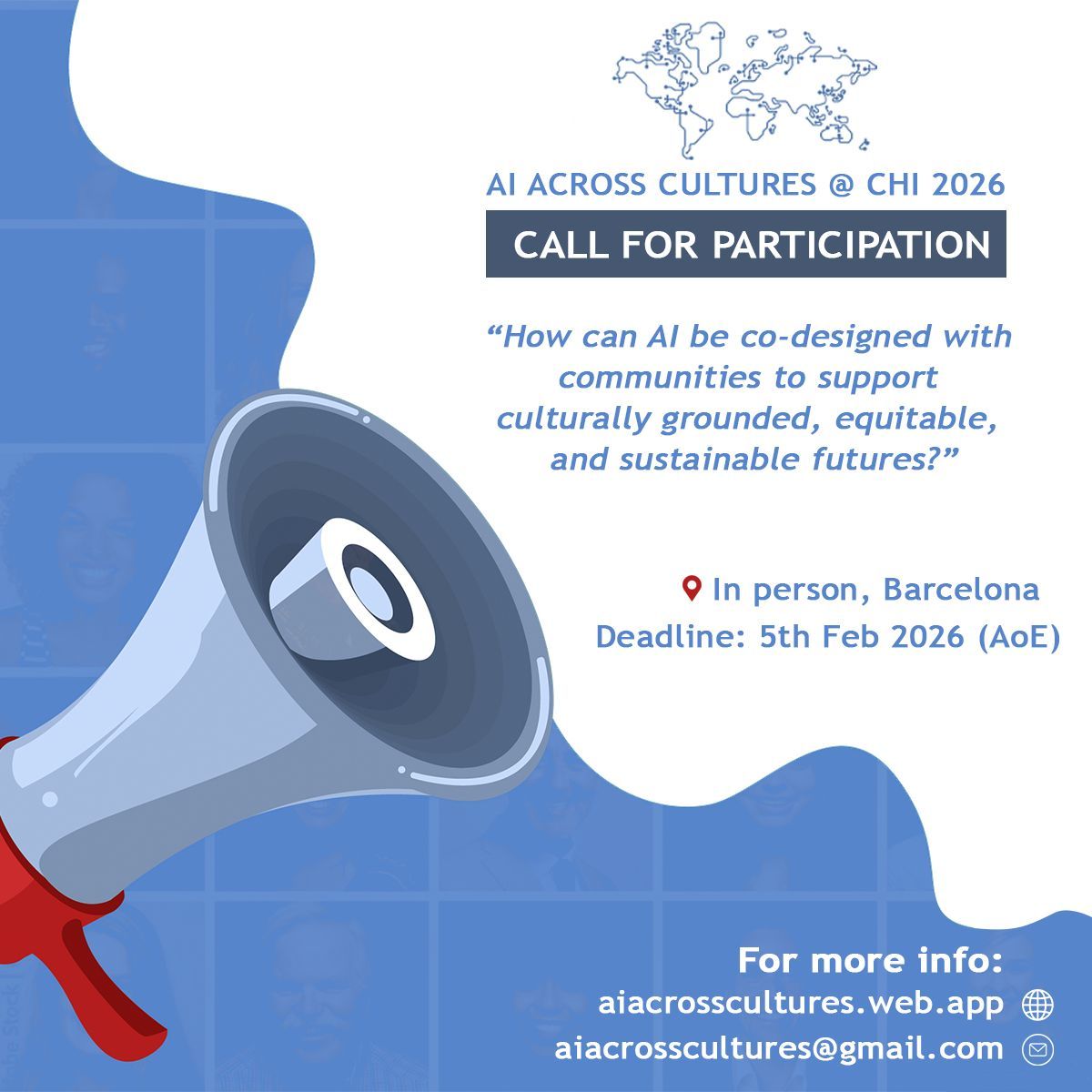
We invite you to join us in this critical work. We are accepting Position Contributions until February 5, 2026.
We welcome submissions in two formats:
- Papers: 4–6 pages (excluding references) using the ACM Master Article single-column template.
- Alternative Media: Audio, video, artwork, photo essays, or other creative formats accompanied by a 1-page statement of intent.
We are looking for case studies of AI in low-resource contexts, community-led design approaches, frameworks for data sovereignty, and speculative design pieces exploring culturally grounded AI futures.
Key Dates:
- Submission Deadline: 5 February 2026 (Anywhere on Earth)
- Notification of Acceptance: 12 February 2026
- Workshop Date: April 2026 (at CHI 2026 in Barcelona, Spain)
The future of AI does not have to be one where most of humanity is an afterthought. We can build systems that preserve linguistic diversity, strengthen cultural identity, and actually serve the needs of diverse communities. But only if we stop pretending AI is universal and start doing the hard work of making it equitable.
Submit your contribution and learn more at aiacrosscultures.web.app